She found me roots of relish sweet,
And honey wild and manna-dew,
And sure in language strange she said –
‘I love thee true’
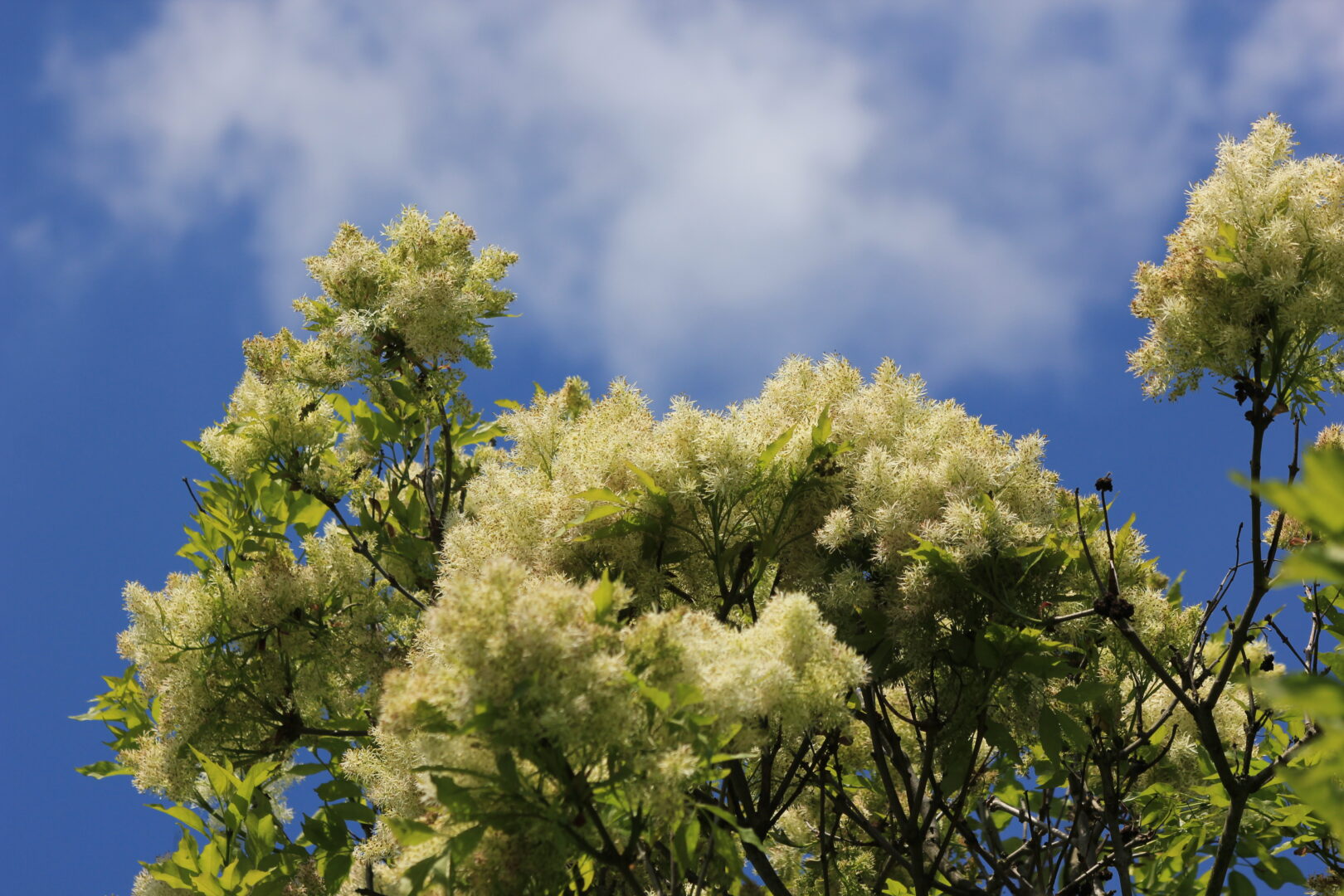
John Keats was referring to manna from our Tree of the Month in this part of his poem “La Belle Dame Sans Merci”. The Manna Ash (Fraxinus ornus) is now covered in a profusion of small white flowers giving it the alternative name of the Flowering Ash.
Entering the Park from the Muswell Hill (Parkland Walk) entrance. It is the first tree on the right.
This is an ash tree with leaves similar to our native ash, but with only 5-9 leaflets making up one leaf against 9-13 leaflets for the common ash. The winter buds are brown whereas the common ash has black buds. The manna ash also keeps a smooth bark as it ages.
The large blousy patches of scented flowers covering the tree indicate that this ash is insect pollinated.
These trees are native to central and south east Europe, the near and Middle East and the Mediterranean. Flowering ashes have been present in this country since about 1700.
The manna in the tree’s name refers to the gum that is still harvested from the tree in southern Italy and which was once believed to be the biblical “manna of heaven”.
The gum is harvested by a mannalaiolo who cuts the bark. The liquid, mostly consisting of a sugar called mannite, then flows and solidifies before being collected. The solid manna can be made into a spread called crema alla manna (available online).
In the UK, the manna ash is an ornamental tree usually found in parks.
Look out for the Judas tree close to the tree of the month by the nearest side of the Little Dinosaurs, it is now producing its purple flowers.
There are more manna ash trees to be found on the eastern edge of the pavilion car park.